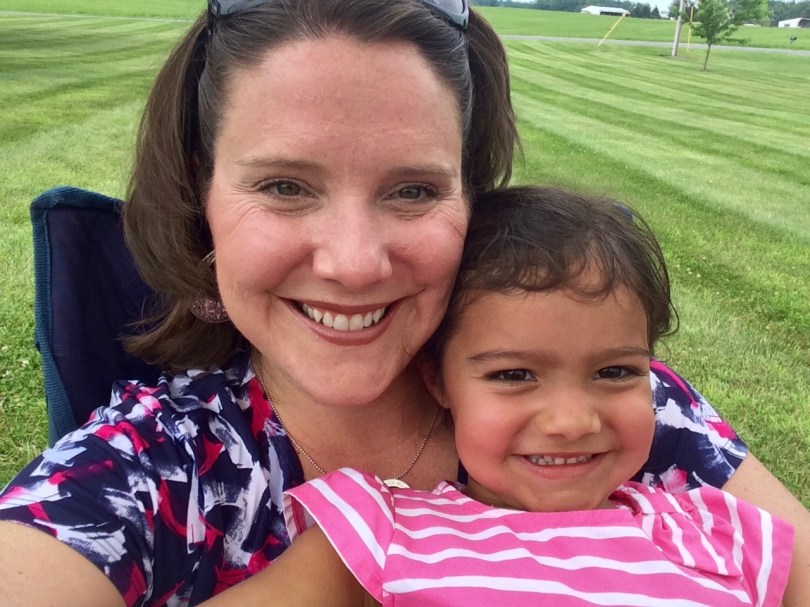
Have you ever expected your child to say “I’m sorry”? Teaching our daughters good manners is important to me. However, there is a far greater opportunity that presents itself when sharing these two simple words. And the real learning comes not from hearing your child say those words to others, but rather in you expressing those words to your child.
Parenting is hard. We all have moments in which we struggle to act from a place of love. We might reach a point of frustration due to the demands of parenting itself, or find ourselves strained due to external pressures from work, money or relationships. Transferring our frustration into our parenting relationship is easy to do – after all, we are the authority figure and may strive to maintain control in our parenting relationship when we may feel like other areas of our life are out of our control.
In these moments of frustration, I challenge myself to take a deep breath, center myself and reconnect with my daughters. And I apologize to them. That’s right, I tell them that “I’m sorry”. But I don’t stop there. I take it a step further to help them understand the emotions that I am feeling in that moment that contributed to my reaction. I use simple words like “I am feeling frustrated” or “I am feeling sad”. And I provide an age-appropriate reason to help them understand why I am feeling those emotions.
I have a conference call at work every day with my team at 8:15am. I need to be focused and present — and my girls need to be at school! — by the time that phone call starts. There are mornings in which our family is running behind schedule for one reason or another. I may start feeling myself become short with the girls if the are not yet dressed or they are eating their breakfast slowly. And this is exactly the moment in which I try to help our girls understand how I’m feeling.
I want to teach our daughters how to express their feelings with openness, honesty and vulnerability. I want them to see that if we are not being self-aware, we can allow our feelings in one area of our life to influence how we act in another area of our life. And I want our daughters to see that I am not perfect and that it is okay to admit that.
One of my favorite social researchers and storytellers is Brené Brown. She shares in her book Daring Greatly: How the Courage to Be Vulnerable Transforms the Way We Live, Love, Parent, and Lead: “The real questions for parents should be: “Are you engaged? Are you paying attention?” If so, plan to make lots of mistakes and bad decisions. Imperfect parenting moments turn into gifts as our children watch us try to figure out what went wrong and how we can do better next time. The mandate is not to be perfect and raise happy children. Perfection doesn’t exist, and I’ve found what makes children happy doesn’t always prepare them to be courageous, engaged adults.”
When we show our children our authenticity and vulnerability, we teach them that life is about learning and growing. We grant them permission to make mistakes. We help to show them how to appropriately express their emotions and how to become comfortable with their imperfection. When we demonstrate the courage to be humble and authentic, we model for our children what it means to be a fully-formed, mature adult. And isn’t that what we want most for our children?


 Parenting with a Mindful Heart